
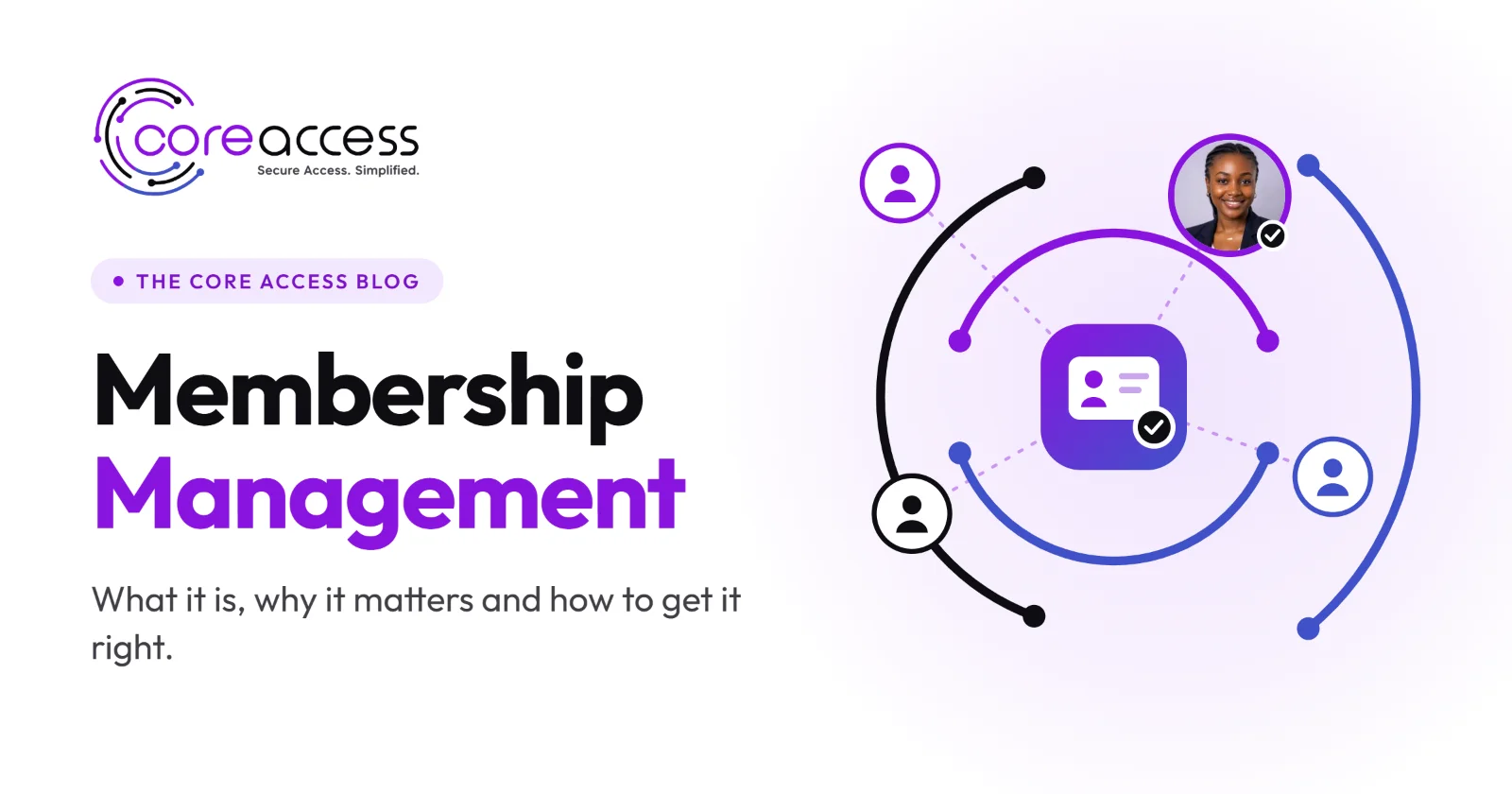
Membership Management: What It Is, Why It Matters and How to Get It Right
As organizations grow, managing members manually becomes harder. This article explores how better membership management can simplify operations, improve member experiences, and give organizations greater visibility - with CoreAccess bringing it all together in one platform.
It is 8:15 a.m.
A member walks into your gym and gives their name at the front desk.
Your staff member opens a spreadsheet.
They search.
Nothing.
They ask for the member's phone number. Another search. Then a WhatsApp message to a colleague.
“Please check if this person has renewed.”
Five minutes later, the answer comes.
The member has renewed. But their record wasn't updated.
It is a small problem.
Until it happens again.
And again.
Now imagine doing this with 500 members.
Or 2,000.
This is where membership management stops being just about keeping a list of names and becomes an important part of running an organization.
Whether you run a gym, club, association, training centre, coworking space, church, school or another membership-based organisation, how you manage your members can affect your team's workload, the member experience and ultimately your revenue.
What Is Membership Management?
Membership management is the process of registering, organising, communicating with and supporting members throughout their relationship with an organisation.
It covers much more than collecting names and phone numbers.
It can include:
Member registration and onboarding
Digital member profiles
Membership plans and renewals
Attendance and check-ins
Payments and payment records
Member communication
Access permissions
Visitor management
Reporting and analytics
Managing members across multiple locations
Think of it as the system behind the relationship between an organization and its members.
When that system works well, things become easier.
Your team can find information quickly. Members can move through the organization with less friction. Managers have better visibility. And decisions can be based on actual information rather than guesswork.
Why Does Membership Management Matter?
Imagine an organization that starts with 30 members.
At that size, almost anything can work.
A spreadsheet works.
A notebook might even work.
A few WhatsApp messages can keep everyone informed.
Then the organization grows.
30 members become 100.
100 becomes 500.
Suddenly, the same processes that once felt convenient start creating problems.
Records are updated late. Renewals are missed. Attendance is difficult to track. Staff spend time searching for information. Different people have different versions of the same record.
The organization has grown.
But its system hasn't.
That is when effective membership management becomes important.
1. It Reduces Manual Administration
Your team shouldn't have to spend a large part of the day looking for information that should already be easy to find.
When member information is organised in one place, staff can spend less time searching through spreadsheets, paper records and messages.
That means more time for the work that actually matters: serving members and running the organization.
2. It Creates a Better Member Experience
Think about the difference between these two experiences.
A member arrives and your team immediately knows who they are, whether their membership is active, and when they last checked in.
Compare that with asking the member to wait while someone searches through different records.
Neither experience is complicated.
But one feels organized.
The other feels frustrating.
Membership management may happen behind the scenes, but members often experience the results directly.
3. It Gives You Better Visibility
You cannot effectively manage what you cannot see.
How many active members do you have?
How many are due for renewal?
Who is regularly attending?
Which memberships have expired?
How many people are using your facilities?
These questions become harder to answer when information is scattered across different places.
A structured membership management system gives organizations a clearer view of what is happening.
4. It Helps Reduce Missed Renewals
For many membership-based organizations, keeping existing members is just as important as bringing in new ones.
But a renewal can easily be missed when there is no structured process for tracking membership status.
A member's subscription expires.
Nobody follows up.
The member moves on.
The organization loses revenue.
A better system makes it easier to know which memberships are active, which are approaching renewal and where follow-up may be required.
5. It Helps You Make Better Decisions
Data becomes useful when it helps you make decisions.
If you know when your members typically attend, which membership plans are most popular or how many members are renewing, you can start asking better questions.
What is working?
Where are members dropping off?
What needs to change?
Where should we invest more resources?
Good membership management doesn't just store information.
It makes information useful.
When Manual Membership Management Starts to Break
Manual processes aren't necessarily a problem when an organization is very small.
The challenge comes when the organization grows, but its systems don't grow with it.
At first, a spreadsheet may be enough.
Then there are multiple spreadsheets.
Then someone creates another file because the first one is outdated.
Then attendance is recorded somewhere else.
Payments are tracked separately.
Renewal reminders are sent through WhatsApp.
Visitor information sits in a notebook at the front desk.
Nobody intentionally designed the process this way.
It simply happened as the organization grew.
And that is often how operational complexity begins.
Digital membership management provides a more structured approach.
Member information can be centralised, attendance can be tracked more easily, renewals can be managed systematically, and teams can have better visibility into what is happening across the organization.
The goal isn't to introduce technology simply because technology exists.
The goal is to make the organization easier to manage.
What Should You Look for in Membership Management Software?
Choosing membership management software isn't about finding the platform with the longest list of features.
It is about finding a system that solves the problems your organization actually faces.
Here are some areas worth considering.
Member Management
Can you easily create, update and manage member profiles?
Your team should be able to access accurate information without searching through multiple files or platforms.
Membership Plans and Renewals
Can you create membership plans and monitor their status?
The system should make it easier to know who is active, who is approaching renewal, and whose membership has expired.
Attendance Management
Can you track attendance and check-ins?
Attendance data can provide useful insight into member engagement and help organisations understand how their facilities or services are being used.
Access Management
Can you control who has access?
Membership and access should work together so that the right people can access the right spaces or services.
Visitor Management
Can you register and monitor visitors?
For organizations where people come and go regularly, having visibility into visitors can be just as important as knowing who your members are.
Reporting and Analytics
Can the system help you understand your organization?
Storing data is one thing.
Turning that data into useful information is another.
A good membership management platform should help managers see what is happening and make more informed decisions.
Scalability
Will the system still work when your organization grows?
A solution that works for 50 members should ideally be capable of supporting you when you have 500 or 5,000.
Ease of Use
This one is easy to overlook.
A platform can have every feature imaginable and still fail if your team doesn't know how to use it.
The best system should simplify your work, not give you another complicated process to manage.
How CoreAccess Helps
This is where the right technology can make a difference.
CoreAccess brings membership management, digital identity, attendance, visitor management and access management together in one platform.
Instead of managing different parts of your operation through disconnected processes, organizations can create a more connected way to manage their people and day-to-day operations.
For a gym, that could mean managing members and attendance more efficiently.
For an estate, it could mean having better visibility of residents, visitors and access.
For a school, club, church or association, it could mean having a more organized way to manage people, records and access.
The use case may be different.
The underlying problem is often the same:
There are people to manage, information to organize, and operations to keep running.
CoreAccess helps bring those moving parts together so organizations can reduce manual work, improve visibility and create better experiences for the people they serve.
And that brings us back to the member who walked through the door at 8:15 a.m.
They shouldn't have to wait while your team searches through a spreadsheet to find out whether they belong.
Your team shouldn't have to spend five minutes looking for information that should take five seconds to access.
As organizations grow, the way they manage their people has to grow with them.
Better membership management starts with better systems.
Manage members, digital IDs and access with CoreAccess
Registration, renewals, QR check-in and access control — in one platform. Start free.
